
Where AI systems are applied
-
 Data center AI
 -
 Cloud computing
 -
 Telco & networking
 -
 High-performance computing
Powering scalable data center AI
As AI systems scale across the data center, Arm-based CPUs play a central role in orchestrating workloads, feeding accelerators, and maintaining efficiency across the rack. With high performance per watt and scalable system design, Arm enables customers to increase AI throughput while reducing power consumption and overall infrastructure cost.

Maximize cloud computing with increased performance
As AI and cloud-native workloads converge, Arm-based CPUs provide the performance and efficiency needed to scale across distributed cloud environments. Arm Neoverse processors deliver performance and efficiency across cloud workloads, enabling cloud AI services at scale.

Enabling the next generation of telco and networking infrastructure
As AI systems become more distributed, networking and control planes play a critical role. Arm enables cloud-native, software-defined networking infrastructure that supports low-latency data movement and system coordination for distributed AI workloads.

Paving the way in HPC
Scientific and research environments increasingly combine simulation, analytics, and AI inference. Arm supports these workloads with efficient architectures and a mature software ecosystem designed for sustained, large-scale operation.

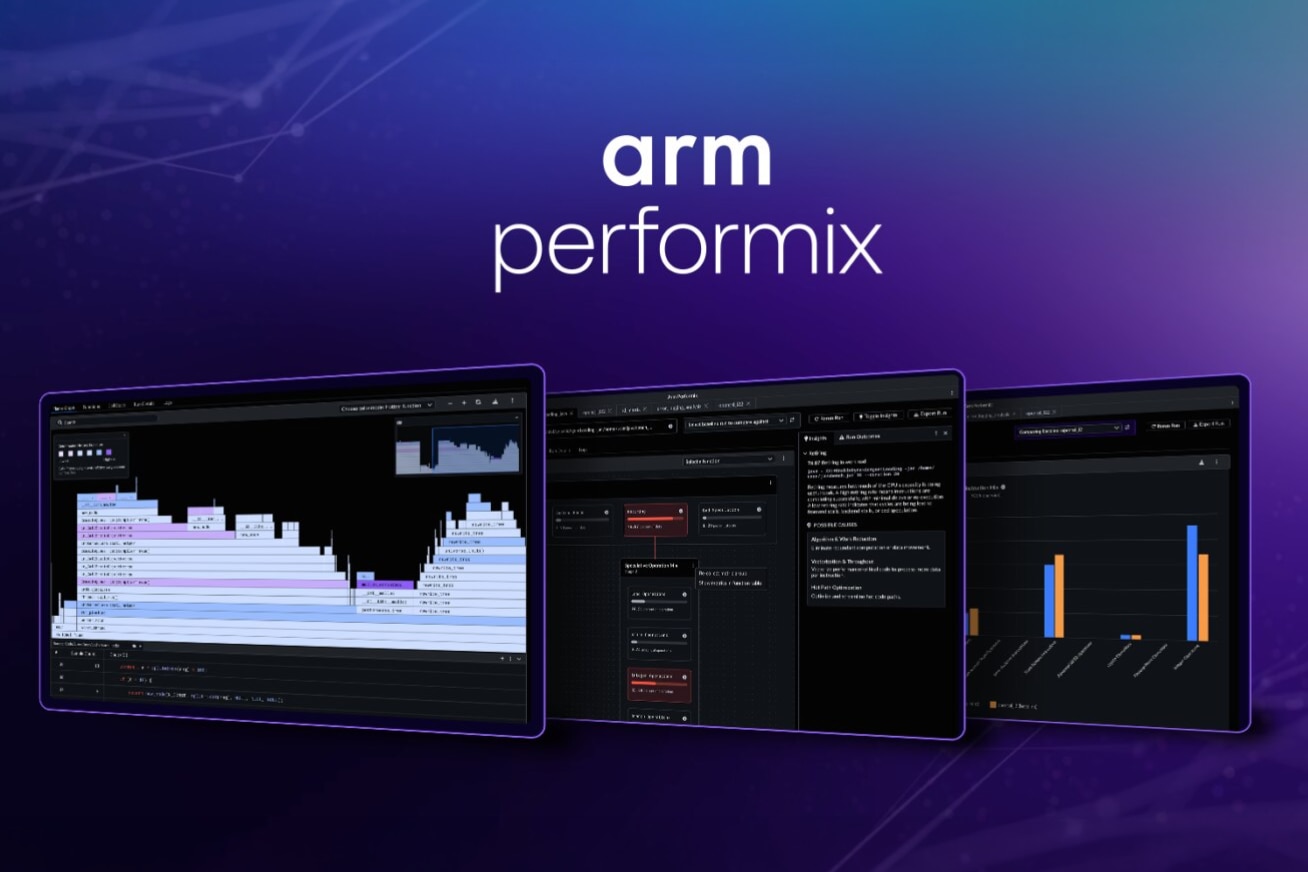
Optimize AI workloads for Arm in the Cloud
Arm Performix is a performance analysis toolkit for developers building AI and large application workloads. It can identify bottlenecks and provide targeted code optimizations to improve efficiency and performance on Arm Neoverse platforms.
Leading hyperscalers are building the future of cloud AI on Arm
Across cloud and data center infrastructure, NVIDIA, AWS, Google Cloud, and Microsoft are advancing Arm-based platforms to power the next wave of scalable, energy-efficient AI innovation.

The NVIDIA Grace Blackwell platform and next-generation Vera Rubin CPUs are built on Arm-based CPU innovation. Featuring 88 Arm-based cores, Vera is designed to power agentic AI and inference across data center and high-performance computing environments.

AWS expands its Arm-based portfolio with Graviton5, delivering up to 25% higher performance and 33% lower latency than the previous generation. Graviton CPUs also empower Trainium3 UltraServers, designed to deliver scalable, cost-efficient infrastructure for large-scale AI workloads.2

Google Cloud Axion-based C4A and N4A instances bring Arm to general-purpose workloads, with N4A delivering up to 2x better price-performance and 80% higher performance per watt compared to x86 offerings. 3

Microsoft Cobalt 100 and Cobalt 200 processors, built on Arm Neoverse, expand Arm-based compute in Azure to support enterprise, cloud-native, and AI-driven workloads with improved efficiency and performance.
Latest news and resources
- NEWS and BLOGS
- Success stories
- White paper


Drive positive change through Arm technology
See how our partners are building the future and powering AI to work for everyone, everywhere.

Defining CPU and software stack performance for agentic AI
Agentic AI expands CPU workloads beyond inference. This white paper proposes a use-case-driven methodology combining component-level and end-to-end benchmarking to measure the infrastructure behind completed tasks.

FAQs
What is a converged AI data center?
A converged AI data center integrates compute, accelerators, memory, and networking into a coordinated system designed to run AI workloads efficiently at scale. Unlike traditional architectures, convergence treats AI as a system-level problem rather than a collection of isolated components.
Why are CPUs central to converged AI data centers?
While accelerators drive model computation, CPUs underpin the systems that turn AI into real-world services. Every AI data center—whether for training or inference—relies on CPU-based head nodes to coordinate accelerators, manage memory, handle pre- and post-processing, and maintain system control.
As inference becomes more persistent and agent-based, these coordination tasks expand. AI systems increasingly depend on CPUs to schedule work, manage state, support key-value caching and vector databases, and handle continuous interaction with data and services. In this environment, efficiency and core density become as important as peak performance.
How does Arm improve performance per watt for cloud AI?
Arm CPUs are designed for efficiency, enabling more usable compute within fixed power and cooling limits. This allows cloud providers to scale AI capacity without proportional increases in energy consumption.
How does Arm compare to x86 for cloud AI?
For cloud AI at scale, Arm-based platforms deliver the performance-per-watt and core density required to maximize rack-level efficiency and control total cost of ownership. Designed for sustained inference, agent orchestration, and accelerator coordination, Arm enables higher workload density and lower power consumption across hyperscale environments. This combination of efficiency, scalability, and cloud-native ecosystem support makes Arm a stronger choice than legacy x86 platforms for modern cloud AI infrastructure.
Can enterprises use Arm for cloud AI data centers, or is it only for hyperscalers?
While hyperscalers lead adoption, Arm-based cloud AI platforms are increasingly available to enterprises of all sizes, supported by a broad software and hardware ecosystem.