
Key use cases for robotics
Humanoids
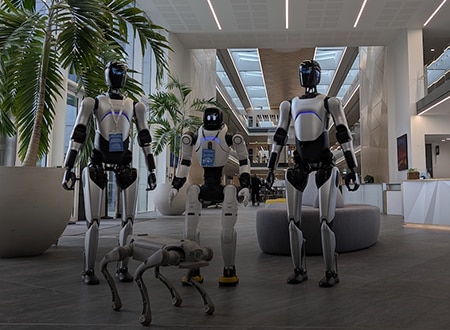
Humanoid robots are designed to operate safely and autonomously in human environments, performing tasks that require perception, mobility, manipulation, and interaction. Unlike traditional robots, humanoids must navigate unstructured spaces, understand human intent, and adapt in real time to dynamic conditions.

Drones & aerial systems
Aerial autonomy demands maximum performance per watt. Arm’s power-efficient compute enables drones to run advanced onboard intelligence, supporting real-time perception and decision-making within strict thermal and flight-time constraints.

Collaborative robots
Collaborative robots, or cobots, are designed to work safely alongside humans, sharing workspaces and assisting with tasks such as assembly, packaging, material handling, and quality inspection. Unlike traditional industrial robots, cobots must combine precision and adaptability with constant awareness of human presence.

Autonomous mobile robots
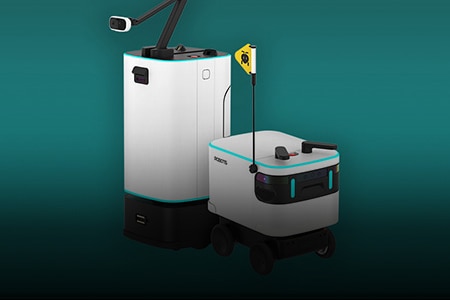
Autonomous mobile robots (AMRs) are designed to navigate dynamic, human-centric environments without fixed infrastructure, enabling flexible automation in warehouses, factories, hospitals, and commercial facilities. Common use cases include material transport, order fulfillment, inventory management, and last-meter delivery, where AMRs must operate reliably alongside people and other machines.



Latest news and resources
- News and blogs
- White paper


The missing science of robotic systems
Learn how addressing key architectural challenges can enable the next generation of intelligent, trustworthy, and scalable physical AI systems.

FAQs
What role does Arm play in modern robotics?
With deep system-level architecture expertise and a broad ecosystem, Arm makes it easier to build, deploy, and scale intelligent robotics.
Why are functional safety and cybersecurity important in robotics development, and how does Arm help?
Functional safety keeps robots predictable and protects people, while cybersecurity safeguards data and prevents attacks. Arm’s built-in safety and security technologies help developers build intelligent robots that are safety-enabled, trusted, and reliable.
Which Arm technologies are commonly used in robotics systems?
Robotics platforms commonly use Arm Cortex CPUs, to balance AI performance, real-time control, and energy efficiency.
What makes Arm essential for building intelligent robots?
Arm’s tools and ecosystem empower developers to build smarter, faster, and more scalable machines. Arm makes it easier to deploy AI, control systems, and sensors across robots, so teams can focus on innovation.