
Why choose Zena CSS Safety
Arm Zena CSS Safety helps OEMs and Tier-1 suppliers achieve next-generation safety and performance goals faster.

ASIL D safety integrity
Provides ASIL D-capable systematic and diagnostic functionality to support safety-critical workloads.

Dedicated safety island
Manages real-time fault detection, diagnostics, and recovery across system domains.

Comprehensive safety documentation
Includes integration guidance and compliance materials to accelerate certification.
Safety benefits of Arm Zena CSS
-
Provides ASIL D-capable systematic and diagnostic functionality for ADAS and IVI workloads on the compute platform.
-
Enhances system reliability with a dedicated Safety Island that supports consistent fault collection and management at the system level to maintain high-integrity operation.
-
Accelerates time to market with comprehensive safety documentation that provides easy-to-integrate safety features and guidance to help partners move faster toward compliance and production readiness.


Features and capabilities of Zena CSS Safety
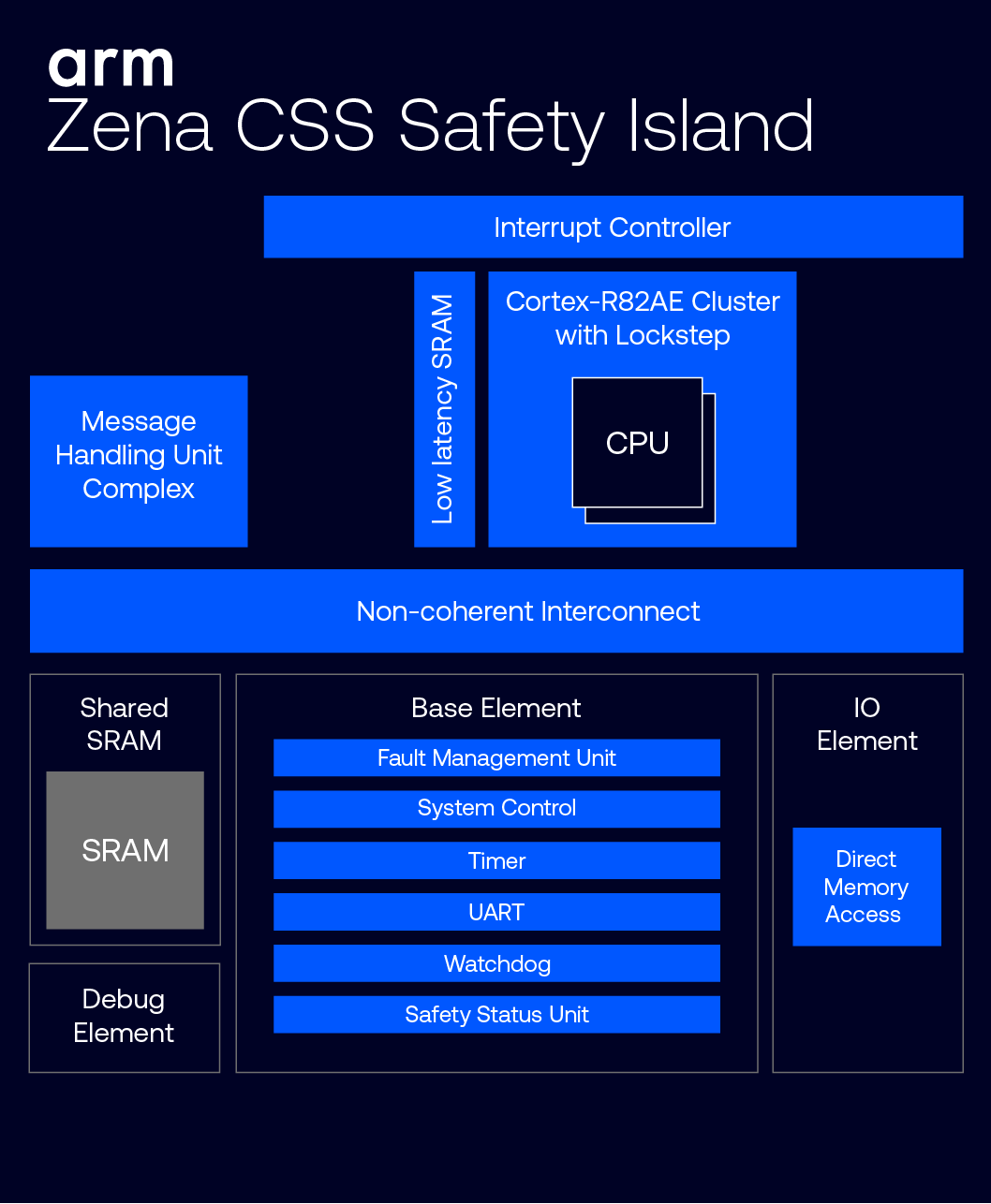
Arm Zena CSS Safety integrates a purpose-built Safety Island within the Zena CSS platform to manage system-level reliability:

Cortex-R82AE cluster– Lock-stepped cores providing ASIL-D-capable systematic and diagnostic functionality.

Cortex-A720AE cores with hybrid mode, transient fault protection, Software Test Library (STLs), and memory protection enable ASIL B workloads to be deployed.

Fault Management Unit (FMU)–Detects, classifies, and responds to hardware faults in real time.

Always-On Isolation – Operates within a dedicated power and clock domain, monitoring clock, voltage, and reset states independently.
Arm Zena CSS Safety specifications
- Built on a lock-stepped Cortex-R82AE cluster for ASIL D diagnostic and systematic capability
- Manages clock, voltage, and system reset functions
- Plays a critical role in system boot-up
- Operates in an always-on, isolated power and clock domain
- Executes safe diagnostic monitoring independently of main compute
- Integrates a Fault Management Unit (FMU) to detect, classify, and respond to hardware faults
- Includes a Message Handling Unit for secure internal communication across the platform
Safety for AI and CSS for heterogeneous redundant executions
Arm Zena CSS delivers energy-efficient, heterogeneous processing to boost AI performance across autonomous driving, in-vehicle experience, and predictive maintenance. It enables redundant execution strategies and sensor cross-checks, with the Safety Island orchestrating reliable and scalable operation for evolving AI needs.

Safety for autonomy
As ADAS expectations and NCAP standards evolve, delivering new features quickly is a key differentiator for automakers. Arm Automotive CSS accelerates silicon deployment and provides a compute platform designed to support ASIL D-capable workloads for ADAS and autonomous applications.

Safety for safe digital cockpit
Arm Zena CSS consolidates mixed-criticality workloads—infotainment, instrument cluster, and AI-powered assistants—on a single ECU to support rich user experiences. Combined with Arm ISP and GPU portfolio, it enables driver monitoring, safety-ready graphics for tell-tales, and safety-island-based plausibility checks.


Success stories powered by Arm Zena CSS Safety

AWS builds automotive AI on Arm

Volkswagen’s intelligent driving future
ROBOTIS AI autonomous robots
Latest news and resources
- News and Blogs
- Podcasts


Key takeaways
-
Delivers ASIL D-capable compute for real-time, safety-critical physical AI workloads.
-
Dedicated Safety Island ensures fault management and diagnostics at the system level.
-
Enables heterogeneous redundancy for AI and autonomous workloads.
-
Comprehensive safety documentation and features to accelerate ISO 26262 compliance.
-
Builds on Arm AE IP for next-generation compute.

FAQs
What makes Arm Zena CSS Safety different from standard compute platforms?
Arm Zena CSS Safety integrates a dedicated Safety Island built on Cortex-R82AE processors, providing ASIL D-capable systematic and diagnostic functionality for real-time control and fault management beyond conventional compute systems.
How does Zena CSS Safety help accelerate certification?
Zena CSS Safety includes ISO 26262-ready documentation and safety features that simplify audits and support compliance efforts, helping teams accelerate certification.
Can Zena CSS Safety support AI and autonomous workloads?
Yes. Its scalable architecture enables redundant execution, ensuring safe and verifiable AI performance for ADAS and autonomous systems.
What is the role of the Safety Island within Zena CSS Safety?
The Safety Island continuously monitors system health, manages diagnostics, and executes safe recovery operations independently of the main compute domain.
How does Arm Zena CSS Safety reduce total cost of ownership?
By offering pre-validated, safety-ready IP and integration guides, it reduces design rework and long-term maintenance costs while speeding product development.